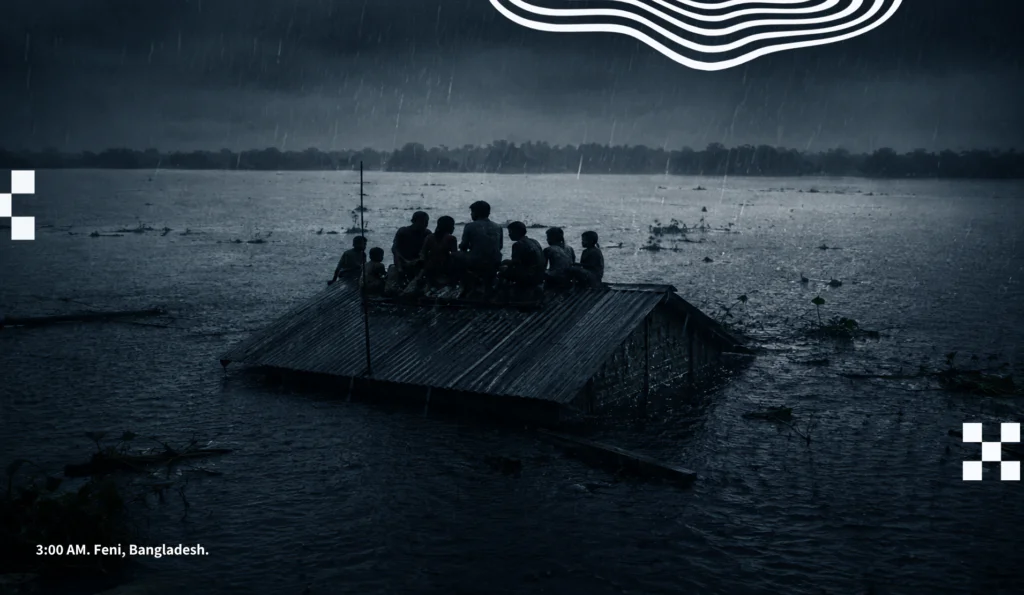
3:00 AM in Feni: Where Hope Meets Technology
Picture this: It’s 3:00 AM in rural Bangladesh. The power grid collapsed twelve hours ago. Local cellular towers are completely submerged. On a single tin roof, a school teacher shelters twenty stranded children as floodwaters rise at three inches per hour.
A 7-year-old girl is suffering from severe dehydration. The medicine that could save her sits trapped in a relief truck 8 kilometers away—stuck on a submerged highway.
In traditional disaster response, that truck cannot move. Boats cannot fight the night currents. To the outside world, those on the roof are completely invisible.
But what if they weren’t?
Enter AeroMesh: The Infrastructure-Agnostic Lifeline
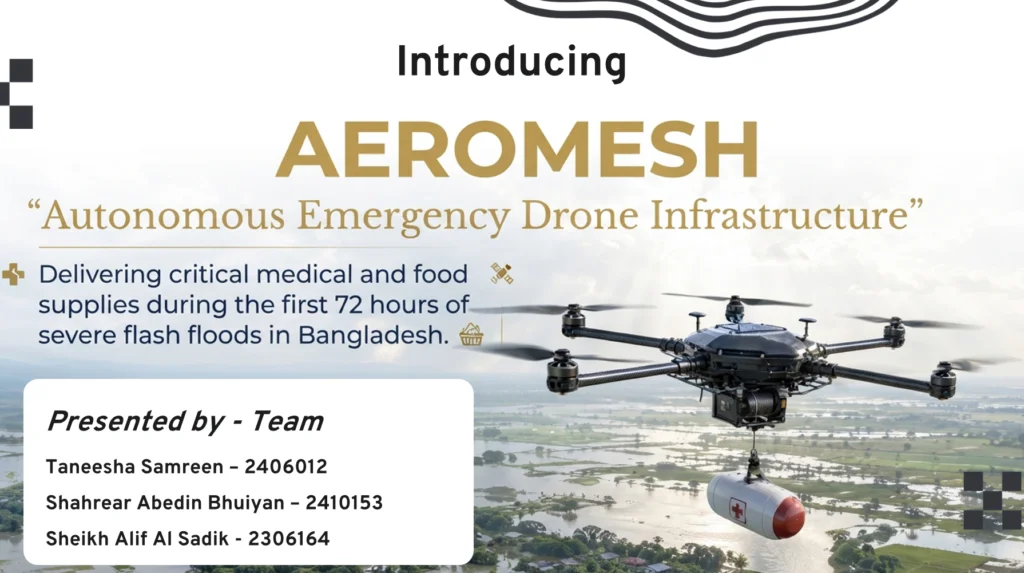
Team Lumina’s project, AeroMesh, is an autonomous emergency drone infrastructure designed to deliver critical medical and food supplies during the first 72 hours of severe flash floods in Bangladesh.
Here’s the game-changer: While standard drones fail when cell towers go down, AeroMesh uses an infrastructure-agnostic LoRa mesh network. These rugged, waterproof drones communicate and navigate completely independent of local mobile networks.
Operating from mobile water-vessel command bases and lowering floating life-capsules via a precision winch mechanism, AeroMesh bypasses submerged roads, dangerous water currents, and chaotic landing hazards.
Why Traditional Drones Fail
| Aspect | Ad-Hoc Drone | AeroMesh Drone |
|---|---|---|
| Network Dependency | Relies on 4G/5G towers; 0% success when networks fail | 100% infrastructure-agnostic; creates its own mesh network |
| Navigation | Manual piloting via visual line-of-sight | Autonomous swarm pathfinding; dynamic obstacle routing |
| Delivery | Requires flat, dry surfaces or dangerous hand-drops | Precision winch system; hovers safely above hazards |
| Payload & Power | Fixed capacity; manual battery swaps on land | Modular payload; rapid automated battery-swapping |
| 72-Hour Response | Limited to single drone’s battery radius | Extensive swarm coverage from moving vessels |
How It Works: The Five-Step Lifeline
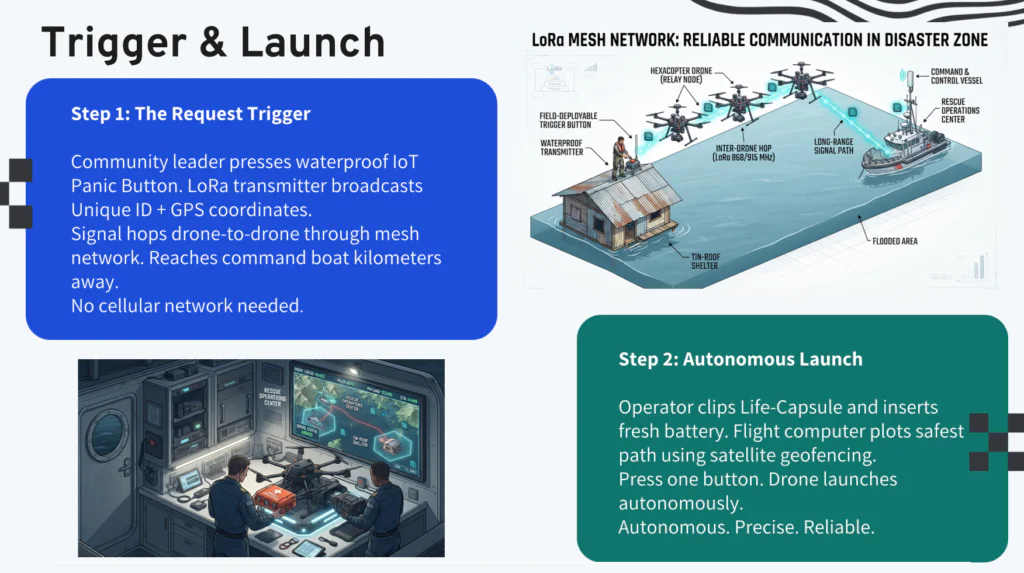
Step 1: The Request Trigger
A community leader presses a pre-distributed, waterproof IoT Panic Button. The button uses a low-frequency LoRa transmitter to broadcast a data packet containing the unique ID and GPS coordinates—no cellular network required.
The signal hops from drone to drone through the LoRa Mesh Network until it reaches the rescue command boat 6 kilometers away.
Step 2: Autonomous Path Planning
At the command boat, an operator clips a pre-loaded Life-Capsule onto the drone. The flight computer autonomously plots the safest path using satellite geofencing to avoid power lines. The drone launches with a single button press.
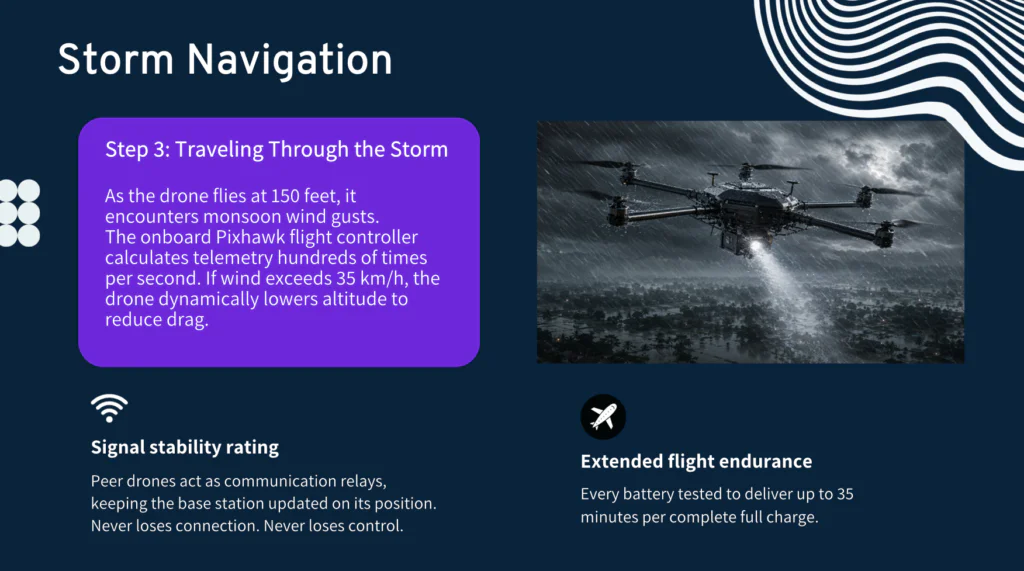
Step 3: Traveling Through the Storm
Flying at 150 feet, the Pixhawk flight controller calculates telemetry at hundreds of times per second. If wind gusts exceed 35 km/h, the drone dynamically adjusts altitude to maintain stability.
Step 4: The Winched Precision Drop
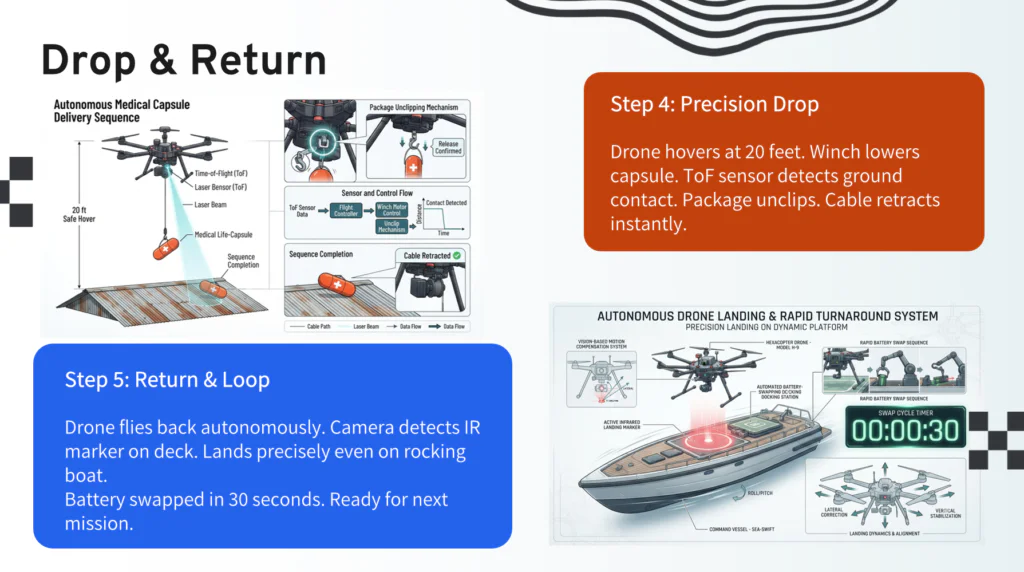
This is where AeroMesh truly shines. The drone hovers safely at 20 feet—well out of reach. An internal motorized winch slowly lowers the capsule down. The capsule detects contact with the roof surface, mechanically unclips the package, and the winch retracts instantly.
No broken medicine bottles. No chaotic scuffles. Just precision delivery.
Step 5: The Autonomous Return
The drone flies back to the command boat, using an infrared marker on the deck for precision landing—even as the boat gently rocks on the water. The battery is swapped in 30 seconds, and the drone is ready for the next run.
The Hardware: Built for Monsoon Conditions
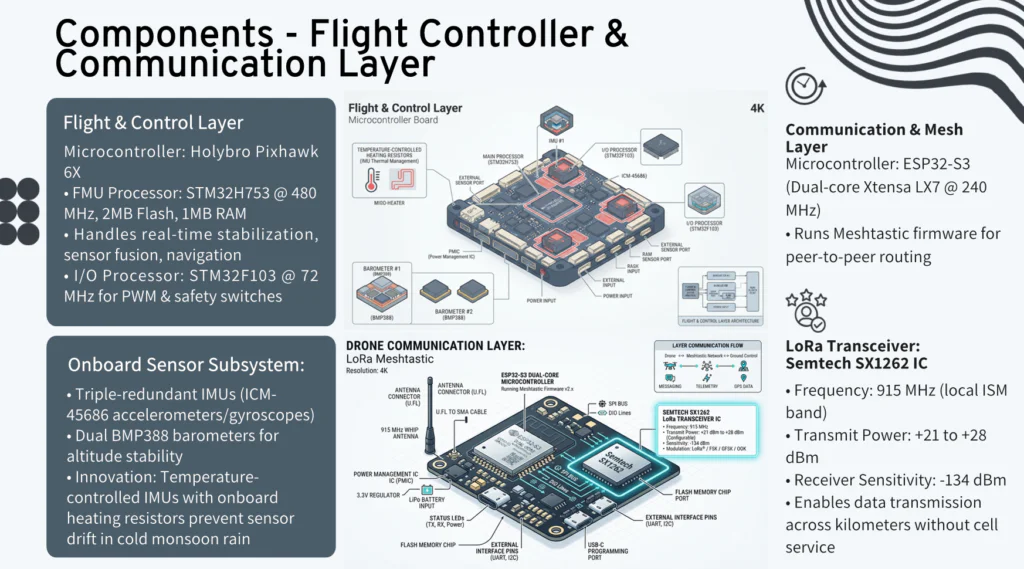
Core Flight Controller (The Drone’s Brain)
Microcontroller: Holybro Pixhawk 6X (STM32H753, 480 MHz)
Triple-redundant IMUs with temperature-controlled heating resistors to prevent sensor drift in monsoon rain
Dual barometers for altitude precision
Communication Module (The Mesh Node)
ESP32-S3 running Meshtastic firmware
Semtech SX1262 LoRa Transceiver operating at 915 MHz with -134 dBm sensitivity
Enables data transmission across several kilometers without cell service
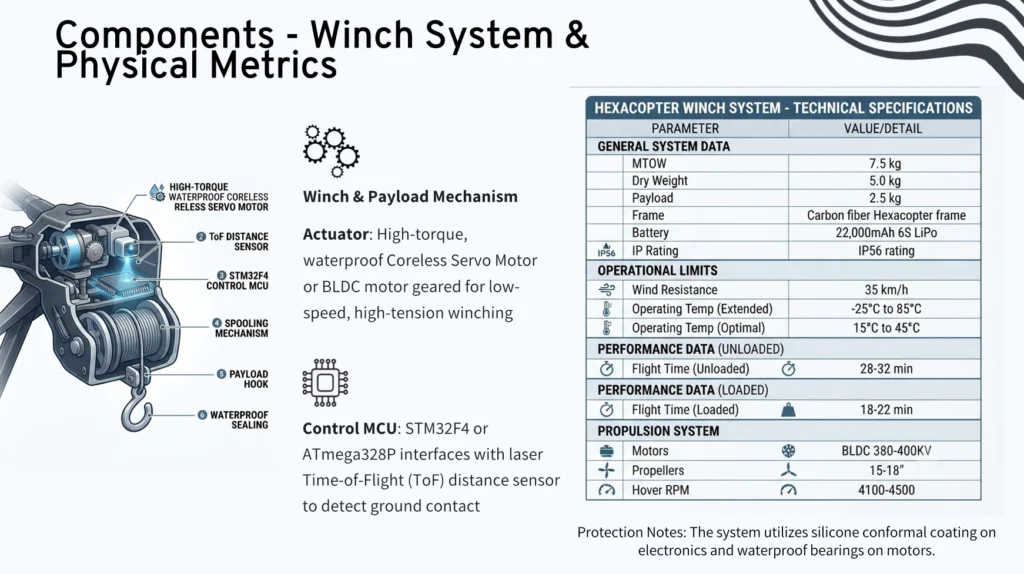
Winch & Payload Mechanism
High-torque waterproof servo motor
Laser Time-of-Flight sensor for precision package release
Physical Specifications
| Metric | Value |
|---|---|
| MTOW | 7.5 kg |
| Dry Weight (with battery) | 5.0 kg |
| Payload Capacity | 2.5 kg |
| Operational Temperature | 15°C to 45°C |
| IP Rating | IP56 (waterproof) |
| Wind Resistance | Up to 35 km/h gusts |
| Mission Flight Time | 18-22 minutes (fully loaded) |
| Motor RPM | 4,100-4,500 at hover |
The Market Opportunity in Bangladesh
Bangladesh faces recurring flood disasters, creating an urgent need for innovative disaster response solutions. AeroMesh targets the growing drone logistics market with:
B2B Integration: Partnerships with logistics providers, pharmaceutical companies, and NGOs
B2G Integration: Government emergency response agencies, military, and disaster management authorities
The addressable market includes emergency medical delivery, search and rescue operations, and disaster relief supply chains—sectors that are rapidly embracing drone technology.
Proprietary Advantage
What sets AeroMesh apart?
Infrastructure independence (no cellular network required)
Mesh network communication for extended range
Precision winch delivery system for hazardous environments
Automated battery-swapping for continuous operations
All-weather capability (IP56 rated, wind-resistant)
Frequently Asked Questions
How is AeroMesh different from regular delivery drones?
AeroMesh operates completely independently of cellular networks using a LoRa mesh network. While standard drones rely on 4G/5G connectivity, our system creates its own communication infrastructure, making it the only viable solution when telecommunications collapse during natural disasters.
What makes the delivery system safer than traditional methods?
Our precision winch mechanism allows the drone to hover at a safe 20-foot altitude while lowering the capsule. This eliminates the need for dangerous landing on unstable surfaces or risky hand-drops that could break medical supplies or cause injuries.
How does AeroMesh handle Bangladesh's monsoon weather?
Every electronic component is protected with silicone conformal coating, motors feature waterproof bearings, and the system is rated IP56. The drone can operate in continuous heavy downpours and withstand wind gusts up to 35 km/h.
What types of supplies can AeroMesh deliver?
The modular payload system can carry up to 2.5 kg of critical supplies including medical kits, Oral Rehydration Saline, water purification tablets, high-calorie energy bars, emergency communication devices, and essential medicines.
How long does a typical mission take?
A standard mission covering 6-8 kilometers takes approximately 18-22 minutes with a full payload. The automated battery-swapping system at the command base reduces turnaround time to just 30 seconds per drone.
Can AeroMesh operate without GPS?
While GPS is the primary navigation method, the system incorporates redundant navigation capabilities including inertial navigation and peer-to-peer position sharing through the mesh network, ensuring continuous operation even if GPS signals are compromised.
How many drones operate simultaneously?
The mesh network architecture supports swarm operations with up to 50+ drones operating simultaneously, providing extensive coverage across large disaster zones and maintaining continuous supply chains.
Who handles the emergency requests?
Pre-distributed IoT Panic Buttons are given to community leaders, school teachers, and local government officials in flood-prone areas. These buttons work even when cellular networks are completely down.
What happens if a drone malfunctions mid-mission?
The system includes safety features such as automated return-to-home protocols, peer-to-peer relay capabilities, and parachute deployment in case of catastrophic failure. The mesh network ensures other drones can reroute to cover any gaps.
How does the command boat maintain stability for drone landings?
The automated landing system uses downward-facing cameras and infrared markers on the deck, combined with adaptive landing algorithms that compensate for gentle rocking motions, ensuring safe landings even on moving vessels.
The Bottom Line
AeroMesh isn’t just about flying drones. It’s about building a lifeline when the entire world goes dark. It’s about ensuring that a 7-year-old girl on a flooded roof in Feni gets her medicine—even when the cellular networks are down, the roads are flooded, and traditional rescue teams cannot reach her.
This is disaster response for the 21st century.